 |
 |
|
| |||||||||||||||||||||||||||||||||||||||||||||
|
March 10, 2009
Manny Becoming Manny
Permalink A new book on Manny Ramirez hits the stands today, Becoming Manny: Inside the Life of Baseball's Most Enigmatic Slugger Q. If you had to diagnose him, what would you say? I have a cousin who plays accordion. She competed when she was young at the state and national level and did very well. I've seen her in the flow state. She would just rest her head on the instrument and play, almost in a trance. I guess Bostonians should have just gone with the flow. Posted by StatsGuru at 09:01 AM
| Comments (0)
| TrackBack (0)
March 03, 2009
Ducksnorts Published
Permalink Ducksnorts announced their new baseball annual is available. For fans of the Padres, this is a must read. You can order the book here. Posted by StatsGuru at 09:10 AM
| Comments (0)
| TrackBack (0)
March 02, 2009
Reading Torre
Permalink Roger Angell reviews The Yankee Years Verducci has range and ease; he's a shortstop on the page. He gets us into the visiting-team clubhouse before the sixth game of the Yankees-Red Sox American League championship in 2004 (the Red Sox have come back from three games down), where Kevin Millar, ringleader of "the Idiots," as the hilariously loose team is known, tells manager Terry Francona that the Sox will not be taking practice that night, in order to avoid "Yankeeography crap" up on the stadium's video board. "Whatever you guys want," Francona says. Millar then tours the clubhouse, doling out slugs to his teammates from a bottle of Jack Daniel's he's come upon, and the Sox go out and nail the game. Angell comes off very sympathetic to Torre in the review. Please donate to the Baseball Musings Pledge Drive. Posted by StatsGuru at 02:20 PM
| Comments (0)
| TrackBack (0)
February 25, 2009
Spring Books
Permalink I just received an email that The Bill James Gold Mine 2009 Posted by StatsGuru at 07:24 PM
| Comments (0)
| TrackBack (0)
Christmas is Over
Permalink Major League Baseball will no longer publish a hard copy of the Red and Green books. For those of you who never came across one of these, they were one of the staples of baseball researchers before computerized stats came along. For me in the 1990s, they were my source for who was a rookie and how much service time each player had earned. They are, however, obsolete. All this information is available online, and is updated daily. I can't argue with the decision. Posted by StatsGuru at 06:54 PM
| Comments (2)
| TrackBack (0)
February 23, 2009
Guiding Rays
Permalink The DRays Bay 2009 Tampa Bay Rays Guide is available for download. Posted by StatsGuru at 02:30 PM
| Comments (0)
| TrackBack (0)
February 13, 2009
Making Money off The-Rod
Permalink Selena Roberts's book about Alex Rodriguez will be available a month early, just in time for the opening of Yankee Stadium. I wonder if it will be available at the souvenir stands? Posted by StatsGuru at 07:07 PM
| Comments (6)
| TrackBack (0)
February 11, 2009
Ominous Book
Permalink Selena Roberts tells the story of her Alex Rodriguez scoop to the New York Observer. The last paragraph indicates there's more to come: "The book is still a work in progress," said her book editor, Mr. Hirshey. "I assure you she has more drug revelations as well as other news. Not everything that Selena has on A-Rod's steroid participation has come out yet." Hat tip, Deadspin. Posted by StatsGuru at 08:38 PM
| Comments (0)
| TrackBack (0)
Bad Things 'Bout the Mets
Permalink Darryl Strawberry penned a book about his days with the Mets, who appeared to be lusty, zesty men. "We were the boys of summer. The drunk, speed-freak, sneaking-a-smoke boys of summer," writes onetime home-run legend Darryl Strawberry in "Straw: Finding My Way," out in April from Ecco. "[An] infamous rolling frat party . . . drinking, drugs, fights, gambling, groupies." I remember talking to a colleague of mine who worked on Mets broadcasts about Keith Hernandez. I made some comment about Keith Hernandez stopping cocaine use after his conviction, and my friends said, "What makes you think he stopped?" Keith and Ron Darling might have an interesting time in the Mets booth this summer. Posted by StatsGuru at 12:15 PM
| Comments (5)
| TrackBack (0)
February 06, 2009
The Female Fan
Permalink We've Got Heart continues their series on women in baseball with a profile of Jane Heller, author of Confessions of a She-Fan: The Course of True Love with the New York Yankees Posted by StatsGuru at 10:18 AM
| Comments (0)
| TrackBack (0)
February 04, 2009
Torre Spinning
Permalink Tyler Kepner read The Yankee Years and says Joe Torre is spinning his A-Fraud reference: Here is the actual passage, as written by Torre and Tom Verducci: "Back in 2004, at first Rodriguez did his best to try to fit into the Yankee culture - his cloying, B-grade actor best. He slathered on the polish. People in the clubhouse, including teammates and support personnel, were calling him 'A-Fraud' behind his back." Seems like Joe didn't like the reaction the leaked snippets received. Posted by StatsGuru at 10:57 PM
| Comments (6)
| TrackBack (0)
February 03, 2009
Book Debut
Permalink Sam Borden is at the Joe Torre book signing. Posted by StatsGuru at 01:23 PM
| Comments (0)
| TrackBack (0)
January 31, 2009
Talking to Verducci
Permalink Alex Belth interview Tom Verrducci about his new Joe Torre book at SI. Posted by StatsGuru at 09:36 AM
| Comments (0)
| TrackBack (0)
January 27, 2009
Torre Speaks
Permalink Joe Torre talks about his book with the New York Times. Posted by StatsGuru at 04:51 PM
| Comments (1)
| TrackBack (0)
January 26, 2009
Overblown?
Permalink From the reports I'm seeing today, yesterday's Torre controversy was a bit overblown. Posted by StatsGuru at 12:37 PM
| Comments (2)
| TrackBack (0)
January 25, 2009
Torre's Revenge
Permalink Via BBTF, Susannah Cahalan and James Fanelli get an advanced look at Joe Torre's new book. It's not a kind look at the Yankees: Scorned skipper Joe Torre is blasting the Yankees - calling many of his former players prima donnas, confessing he stopped trusting the powers that be years before he left the team and charging that general manager Brian Cashman betrayed him. I'm a bit surprised by this. Not that these things went on, but that Joe would make them public. Torre's reputation is all class, and this calls that into question. Update: Here's another post that agrees Torre is losing some of his classiness here. Posted by StatsGuru at 10:18 AM
| Comments (10)
| TrackBack (0)
January 20, 2009
Another Drug Book
Permalink Michael Schmidt at the New York Times weaseled a copy of Kirk Radomski's new book posts a review. Craig Calcaterra reviews the review: In any event, after reading Schmidt's article, I hope that none of you feel an overpowering need to go buy Radomski's book. There is so much garbage being published these days that we shouldn't be in the business of encouraging any more of it. I actually find it interesting that Radomski names names that aren't in the Mitchell report, but Schmidt leaves them out of his article. If we knew those names, there would be no reason to buy the book. Posted by StatsGuru at 08:55 AM
| Comments (1)
| TrackBack (0)
December 22, 2008
A Hellish Christmas
Permalink Vertigo Comics sent me a copy of the 250th issue of John Constantine, Hellblazer. There are five stories in the special issue, the first Vertigo to reach 250 issues. The third one caused the issue to come to my house, "All I Goat for Christmas." Constantine is hired to end the Billy Goat curse, and Rafael Grampá's illustration of the curse will give Cubs fans nightmares. One warning, this book is for adult fans of Wrigley. Posted by StatsGuru at 09:20 PM
| Comments (0)
| TrackBack (0)
December 13, 2008
Immediate Video Replay
Permalink I just received Instant Replay: The Day That Changed Sports Forever For fifty years, Verna directed major television events and he tells the story of his life in broadcasting. Having spent some time in production trucks, it's amazing how much broadcasting changed since his invention. It's a nice gift for someone interested in the history of broadcasting. Posted by StatsGuru at 08:41 PM
| Comments (2)
| TrackBack (0)
November 24, 2008
Book Shipping
Permalink The Hardball Times Baseball Annual 2009 (Hardball Times Baseball Annual) Posted by StatsGuru at 12:32 PM
| Comments (0)
| TrackBack (0)
October 28, 2008
The Handbook is Out
Permalink I just received an e-mail reminding me that the Bill James Handbook 2009 (Bill James Handbook) Posted by StatsGuru at 02:53 PM
| Comments (1)
| TrackBack (0)
October 27, 2008
Mysterious Sox
Permalink Jere Smith writes that there will be a reading of his new book, Dirty Water: A Red Sox Mystery Posted by StatsGuru at 08:13 AM
| Comments (0)
| TrackBack (0)
June 30, 2008
Dogs and Franks at 20
Permalink James Crabtree and his friend Ryan set out to find Bob Wood on the 20th anniversary of the publication of Dodger Dogs to Fenway Franks: The Ultimate Guide to America's Top Baseball Parks The lure of the open road, a quest to visit all the sacred green cathedrals of America's National Pastime, and the joy of summer vacation equal the perfect mixture of pure bliss to many. It was certainly the right recipe for one inspired author and scores of his future readers. If baseball is the thinking man's game, then one quintessential book is the thinking baseball fans idyllic daydream of a wistful journey. Twenty years ago Bob Wood was a young 28 year-old high school teacher with an abiding love of baseball and travel. With no prior writing experience he had set out on an epic road trip to visit all 26 Major League Baseball stadiums in one summer. His book, Dodger Dogs to Fenway Franks, quickly became a cult classic with baseball fans around the globe. Today it still endears itself to legions of readers and offers a glimpse of a time in baseball that has now long since passed. Most of the 26 stadiums he visited are gone. Cell phones and GPS devices are common. Laptops, cable television, and the internet have revolutionized life. Steroids and other issues have had their effect upon the game. Yet, somehow baseball remains as beloved as it ever was. Dodger Dogs to Fenway Franks was a fascinating read and was quickly embraced by baseball lovers everywhere. Its author however had long since left the public eye. In fact, he seemed to be missing. Where was Bob Wood? Had he become baseball's J.D. Salinger? Posted by StatsGuru at 07:01 PM
| Comments (5)
| TrackBack (0)
April 30, 2008
Reading List
Permalink Alex Belth polled 55 readers and lists the ten essential baseball books. One I like that didn't make the top ten is The Managers by Bill James. Posted by StatsGuru at 10:31 PM
| Comments (0)
| TrackBack (0)
April 10, 2008
Mayne-ly Funny
Permalink In my time at ESPN, I don't remember working much with Kenny Mayne, but I remember liking him very much. Almost all the anchors I worked with were good people. They had the occasional conniption, as the videos of Chris Berman that popped up on YouTube can attest. I can't say I ever heard Kenny utter a mean word, or knew anyone who didn't love working with the man. As you may or may not know, Kenny and his wife lost a set of twins. It was devastating for them, and Mayne took some time off after the tragedy. Eventually, the couple did have a child. To celebrate, Kenny bought ice cream for ESPN. He sent the owner of the local ice cream parlor to the Bristol studios with tubs of ice cream, and everyone got to make a sundae. On top of everything else, Mayne is hilarious. So I was very happy to receive a copy of An Incomplete and Inaccurate History of Sport: . . . and Other Random Thoughts from Childhood to Fatherhood In rowing, a bunch of men or women sit in a boat and row as hard as they can while another person, the coxswain, yells at them to row even harder. Continuing: For some reason, it's a real big deal at prestigious colleges such as Harvard. Most of the kids who go to Harvard are really smart and will end up owning boats driven by other people, though no oars will be involved and there won't be that much yelling. You'd think, being so smart, all the people at Harvard who want to be on the rowing team would try out for the part where you get to yell at people to row harder than they already can. It's management training. The book has a foreword, a backwords and a forward, all designed to frustrate delay Canadians from getting to the first chapter, Ice Hockey. Kenny, a former football player writes five chapters on tackle football, including indoor tackle football and electric tackle football. It's a funny look at the sports we know well, and an even funnier look at the sports we don't know at all. Posted by StatsGuru at 04:43 PM
| Comments (0)
| TrackBack (0)
Legendary Review
Permalink Rob Neyer's Big Book of Baseball Legends: The Truth, the Lies, and Everything Else All the while Rob's conversational tone makes you think you're sitting there talking baseball with a fellow fan. For those of you who want to know if announcers are telling true stories or embellishing the facts, Baseball Legends is for you. Posted by StatsGuru at 04:16 PM
| Comments (0)
| TrackBack (0)
March 28, 2008
Canseco Contradicted
Permalink Jon Heyman reports on the reason Jose Canseco hates A-Rod: Canseco claims in his new book, Vindicated, that the reason he "hates [Alex Rodriguez's] guts'' is because A-Rod hit on Canseco's then-wife Jessica. However, people who were close confidants of Canseco insist the actual reason the ex-ballplayer despises A-Rod has nothing to do with Canseco's former wife but regards Canseco's true passion, which, of course, is money. Iglesias also dispells the idea that A-Rod hit on Canseco's wife. Posted by StatsGuru at 10:55 PM
| Comments (2)
| TrackBack (0)
March 25, 2008
Early Look
Permalink Joe Lavin got his hands on a copy of Canseco's new book and provides spoilers. Since it's a humor column, I don't know if it's made up or not. Hat tip, FanHouse. Update: The post appears to be real. A-Rod was asked about both accusations and gave a no comment to both. Alex is a lot smarter than Roger Clemens when it comes to keeping his mouth shut about things that might get him in trouble. Update: River Ave. Blues still thinks it's a joke. Posted by StatsGuru at 12:08 PM
| Comments (10)
| TrackBack (0)
March 05, 2008
Snorting the Padres
Permalink In the mail today, Ducksnorts 2008 Baseball Annual. It has all you need to know about the San Diego Padres. I'm looking forward to some free time to read it. The Baseball Musings pledge drive continues through March. Please consider making a donation. Posted by StatsGuru at 05:43 PM
| Comments (0)
| TrackBack (0)
March 04, 2008
Technology Advances
Permalink The Mariners posted their media guide online. This is very useful. In the past, you had to be a member of the media to get one or shell out $5. Now you can just look up numbers anytime anywhere without lugging books around. I hope all teams are doing this. The Baseball Musings pledge drive continues through March. Please consider making a donation. Posted by StatsGuru at 01:13 PM
| Comments (2)
| TrackBack (0)
February 25, 2008
How to Market Baseball Books
Permalink Rays Anatomy provides pictures of the Tampa Bay Rays fanfest. I like this one of the Baseball Prospectus table, showing how they are trying new and different ways to sell their books:
I wonder what their VONS (Value Over Nate Silver) is? :-) Posted by StatsGuru at 05:12 PM
| Comments (4)
| TrackBack (0)
January 17, 2008
The Classics
Permalink Redleg Nation finds a classic book. Posted by StatsGuru at 11:11 AM
| Comments (0)
| TrackBack (0)
January 05, 2008
Ghost Busted
Permalink Jose Canseco's ghost writer quits. "I'm passing," Yaeger told the Daily News. "I had a chance to review the Jose Canseco (material) that he provided me. I don't think there's a book there. I don't know what they're going to do. I don't think he's got what he claims to have, certainly doesn't have what he claims to have on A-Rod. It's a good day for Alex Rodriguez. Posted by StatsGuru at 12:31 AM
| Comments (0)
| TrackBack (0)
December 30, 2007
Re-Juiced
Permalink Jose Canseco's new book is set for an opening day, 2008 release. Given the veracity of Jose's previous book, there are going to be many unhappy players the day the volume hits the stands. Posted by StatsGuru at 04:35 PM
| Comments (1)
| TrackBack (0)
December 27, 2007
Remembering the Devil Rays
Permalink R.J. Anderson published his book on the early years of the Devil Rays, Lamar-itis. It's available via download at the link. Posted by StatsGuru at 09:06 PM
| Comments (0)
| TrackBack (0)
November 30, 2007
Forecasting 2008
Permalink ACTA Sports is now taking orders for Ron Shandler's Baseball Forecaster 2008. Posted by StatsGuru at 12:12 PM
| Comments (0)
| TrackBack (0)
April 15, 2007
The Start of Something Big
Permalink On the 60th anniversary of Jackie Robinson's debut in the major leagues, it seems appropriate to review Opening Day: The Story of Jackie Robinson's First Season Eig provides not only the story of Robinson in that year, but of the struggle for civil rights as a whole in the mid 1940s. Huge demographic shifts took place at that time as soldiers returned from the war, and black Americans among them pushed for eqaul treatment. A wave of relocation brought many black southerners north looking for better jobs, and created an atmosphere in New York City where integration on the baseball diamond would soon become forced. Branch Rickey was stayed ahead of the curve, which allowed him to integrate on his terms. Eig delves deeply into Robinson the man. We get a clear portrait of Robinson's willingness to fight for his rights on two bus ride stories. One, in which he refuses to go to the back of the bus while in the army, led to his court martial. The other, in which he used the power of the purse to persuade a gas station owner to allow the players to use the washroom. Those incidents stand in stark contrast to his first trip to spring training. Airlines found excuses not to fly Robinson and his wife Rachael all the way to Daytona. They ended up on a bus, sitting in the penultimate row. But the driver demanded they move all the way to the back, and Jackie did without argument. It was the first case of him following Rickey's orders to have the strength not to fight back and thanks to the author's prose, we feel Robinsons' struggle with those moments. Eig takes us through the cheers and catcalls, the worries and the triumphs of that amazing season. He describes the scene when the Dodgers returned home from a western road trip in September that won them the pennant: As the Dodgers stepped down onto the train platform along Track Thirteen, some of the less recognizable players mixed with the crowd and escaped, their hats pulled over their faces. Not Robinson. As he walked toward a phone booth, eager to call his wife, some five hundred people -- most of them men, most of them white -- moved with him. He took off running, got to the phone booth ahead of the crowd, and slammed shut the accordion door. When he finished his call, half a dozen policemen rescued him, forming a circle, and, like the front line of the UCLA football team, clearing a path. Robinson took off for the IND subway line, where several pursuing fans begged for the privilege of paying his five-cent fare. At last, he reached his train and climbed aboard. And still, dozens of giddy admirers trailed him. They squeezed into his subway car, their destination of little matter, happy enough just to be along for the ride. This season, think about honoring Jackie Robinson by reading this fine story of his great 1947 season. It reminds us how lucky we and the game are that Robinson succeeded. Posted by StatsGuru at 09:36 AM
| Comments (3)
| TrackBack (0)
April 07, 2007
Ducking the Padres
Permalink The Ducksnorts 2007 Baseball Annual is a perfect book for any Padres fans or for anyone looking to gain a better understanding of the Padres organization. Geoff Young, long time blogger at Ducksnorts presents the material in his usual fascinating way. His mix of opinion and numbers makes for an enjoyable read throughout. There's something there for everyone. I especially liked the chapter on Kevin Towers' trades. He breaks down the best and the worst. Interestingly, his best is one that will surprise people. It netted negative win shares for the Padres, but benefited the organization in many other ways. That's the kind of insight Geoff brings to the book. He's able to look beyond the numbers to support his opinions. His review of the history of the Padres made me realize just how few great players called the city home. They've had incredible right fielders, and of course Trevor Hoffman, but at almost every other position I said to myself, "That's the best they could do?" So if you want to read a complete, in-depth review of the 2006 San Diego season, if you want to learn how this team was built, or even if you're just interested in some history about the organization, the Ducksnorts 2007 Baseball Annual is the book for you. Geoff presents numbers, opinions and history in a very enjoyable style. Don't miss this book! Posted by StatsGuru at 09:52 PM
| Comments (5)
| TrackBack (0)
March 26, 2007
Talking Baseball
Permalink I'll be attending the Baseball Prospectus event at the Yale Barnes and Noble tonight in New Haven. If you're attending, be sure to say hello. Posted by StatsGuru at 01:51 PM
| Comments (0)
| TrackBack (0)
March 22, 2007
Books in the Mail
Permalink Two new books came in the mail in the last couple of days. The Cheater's Guide to Baseball Also recently arrived is the Ducksnorts 2007 Baseball Annual. It features analysis and commentary on the current San Diego Padres, as well as some historical information and lessons the organization can learn from other successful "small market" teams around MLB. You can read more about the Padres at Ducksnorts, the blog. I'll be reviewing both in the next couple of weeks. Finally today I bought Burning Annie Posted by StatsGuru at 08:32 AM
| Comments (0)
| TrackBack (0)
March 08, 2007
Brain Teasers
Permalink Baseball on the Brain Posted by StatsGuru at 07:53 AM
| Comments (0)
| TrackBack (0)
February 14, 2007
Your Guide to Spring
Permalink Florida Spring Training, 3rd Edition: Your Guide to Touring the Grapefruit League (Florida Spring Training: Your Guide to Touring the Grapefruit League) A perfect example of the value of the book is in the section on getting autographs at Chain of Lakes Park, the home of the Indians. After explaining the difficulties of meeting Indians players caused by the layout of the stands, he gives you detailed instructions for meeting Bob Feller and obtaining an autographed picture. The book makes his learned experiences yours. It's the perfect guide if you're headed to the Grapefruit League this year. Posted by StatsGuru at 02:27 PM
| Comments (0)
| TrackBack (1)
February 05, 2007
Author-Rod
Permalink Alex Rodriguez wrote a children's book, Out of the Ballpark "Out of the Ballpark" follows a boy - appropriately named Alex - whose baseball team is playing in the playoffs. Alex, who is a second baseman, makes a key error in the game and begins to put extra pressure on himself. Only his play gets worse. Sound familiar? Maybe when Alex retires he'll take up baseball blogging. He's one of the more intelligent players out there, and his views would certainly add to the discussion. Posted by StatsGuru at 08:33 AM
| Comments (3)
| TrackBack (0)
January 16, 2007
Sheffield the Author
Permalink Gary Sheffield's autobiography is due out soon. Sheffield recounts his dealings with Bonds and BALCO, but there's not much new in that regard. It does shed some light on Sheffield's relationship with Joe Torre: Sheffield called Manager Joe Torre "an enigma" and recalled how, in 2004, his first season in with the Yankees, he grew infuriated that Torre had said he wished the team had signed the slugger Vladimir Guerrero. Posted by StatsGuru at 08:44 AM
| Comments (6)
| TrackBack (0)
January 02, 2007
Remembering the Mets
Permalink Daniel J. Erickson writes that his book about the 1986 Mets, 1986 Mets Memories - A Fan's View of The World Champions Posted by StatsGuru at 07:38 AM
| Comments (0)
| TrackBack (0)
November 30, 2006
Reading Hardball
Permalink The Hardball Times Baseball Annual 2007 is now shipping. There's plenty of time to make it a Christmas present for the baseball fan you love. Posted by StatsGuru at 05:09 PM
| Comments (0)
| TrackBack (0)
November 14, 2006
Handbook Thoughts
Permalink Steve Lombardi reviews The Bill James Handbook 2007 at Netshrine. I just received my copy of The Bill James Handbook 2007 The biggest differences are in the outfield, where the gold glove awards vote for the best outfielders, giving centerfielders an advantage, while this poll was at each position. It's a voting system that's easily implemented and would likely improve the results of the voting, but not as much as I would have thought. Also, in the managers section, take a look at Ozzie Guillen's entry. It's a good lesson in how the makeup of the team effects strategy. In 2005, with a weaker offense team, Guillen stole more, sacrificed more and put runners in motion more often than with his 2006 power team. That's just what a manager should do, as the investment in outs is more costly if it's easier to score a man from first with a long hit. Posted by StatsGuru at 07:25 AM
| Comments (0)
| TrackBack (0)
November 10, 2006
Economizing Baseball
Permalink Just arrived in the mail, an advance copy of The Baseball Economist: The Real Game Exposed Posted by StatsGuru at 08:41 AM
| Comments (0)
| TrackBack (0)
November 07, 2006
The Flood of Free Agency
Permalink In the mail, A Well-Paid Slave: Curt Flood's Fight for Free Agency in Professional Sports Posted by StatsGuru at 08:06 AM
| Comments (0)
| TrackBack (0)
November 02, 2006
Batted Ball Runs
Permalink The Hardball Times provides a preview of their new annual, introducing new metrics on batted balls. Posted by StatsGuru at 09:28 AM
| Comments (0)
| TrackBack (0)
September 14, 2006
Handbook Time
Permalink You can pre-order your copy of the Bill James Handbook 2007 at Amazon now. Now only does it give you the career stats for each player soon after the season is over, but it's full of all kinds of interesting charts on defense, managers, projections and park effects. I always keep my copy next to my computer. Posted by StatsGuru at 02:54 PM
| Comments (1)
| TrackBack (0)
August 01, 2006
Big Little Dreams
Permalink Little Leagues, Big Dreams just arrived in the mail. It looks to be a look at the pros and cons of Little League, and how it's grown into a big business told through the lens of the 2005 Little League World Series. Posted by StatsGuru at 02:23 PM
| Comments (0)
| TrackBack (0)
July 25, 2006
Team-Pedia
Permalink The Team by Team Encyclopedia of Major League Baseball arrived in the mail today. The book presents history, stats, lineups and significant players for each organization. It looks like a nice addition to any baseball library. Posted by StatsGuru at 07:38 PM
| Comments (0)
| TrackBack (0)
July 18, 2006
How Green is my Monster?
Permalink In Feeding the Monster, Seth Mnookin offers an intimate view into the operation of the Red Sox from their sale by the Yawkey Trust to the start of the 2006 season. Seth's prose is enjoyable to read. As I initially skimmed the book, I found my self reading pages into chapters rather than just trying to get the gist of the story. Mnookin spent 2005 with a desk at Fenway, going to meetings, interviewing personnel, almost acting as part of the operation. Through him we learn how the Henry group came together, and how Charles Dolan lost the team by offering money to the limited partners too early. Seth takes us through the long process that developed into the rift between Lucchino and Epstein, something that could have been fixed early if either of them had spoken about it to the other. Manny Ramirez, Nomar Garciaparra, Pedro Martinez and Kevin Millar are all explored in depth. Despite this, I understand Manny no better now than I did before reading the book. The Manny tales are more a rehash of what we know. Mnookin never gets in the player's head. That was a big disappointment. What turned out to be very interesting to me was the tension between Baseball Operations and Marketing. Theo Epstein felt marketing was promising too much to the fans. Epstein realized after the 2005 season the team might need to take a step backward so they could be both a high revenue club and have a strong farm system. But marketing wouldn't listen and that helped drive Theo away from the team in last October. It's a fascinating look at how a team operates, how players behave, and how the media is involved in all of it. While Red Sox fans will love every minute of the book, any baseball fan will enjoy the real-life drama that was the Red Sox over the last four seasons. I highly recommend Feeding the Monster. Posted by StatsGuru at 06:19 PM
| Comments (0)
| TrackBack (0)
July 07, 2006
Monster Mash
Permalink In the Mail, Feeding the Monster by Seth Mnookin. I'm skiming it now, but it's very engaging and appears to be very well sourced. I'll have a more thorough review when I finish. The Boston Globe has highlights. Posted by StatsGuru at 08:41 AM
| Comments (0)
| TrackBack (0)
July 03, 2006
Before the Dodgers
Permalink Ken Aven writes that his first novel, Chavez Ravine Echoes, is now available for purchase. You can read more about Ken at his site. Posted by StatsGuru at 08:54 PM
| Comments (0)
| TrackBack (0)
May 11, 2006
The Belth Interview
Permalink Alex Belth always gets the best interviews. Today he talks to Joel Sherman, author of The Birth of a Dynasty, the story of the 1996 Yankees. Posted by StatsGuru at 03:52 PM
| Comments (0)
| TrackBack (0)
May 01, 2006
Book Drawing
Permalink In Bubble Wrap is offering twenty five copies of Jeff Angus' Management by Baseball. I'm told there are no strings attached, just click on the "I Want One" button and you're entered in the drawing. Posted by StatsGuru at 10:48 AM
| Comments (0)
| TrackBack (0)
April 23, 2006
Baseball Blunders
Permalink I just received Rob Neyer's Big Book of Baseball Blunders in the mail. Rob and a host of guest authors explore some of the famous mistakes in baseball history; trades, managers and players. Yours truly gets a side-bar on Dusty Baker and game six of the 2003 LCS on page 270, so I'm not the most unbiased reviewer. However, I love Rob's books, and if you're a fan of the ESPN columnist, I'm sure you'll love this one too. Posted by StatsGuru at 04:19 PM
| Comments (3)
| TrackBack (0)
April 11, 2006
The Story of Manny
Permalink There's a new children's book about Manny Ramirez. Seems appropriate. Posted by StatsGuru at 08:26 AM
| Comments (0)
| TrackBack (0)
April 08, 2006
Clemente
Permalink The audio version of Clemente, The Passion and Grace of Baseball's Last Hero arrived in the mail. David Maraniss writes and read this biography. The title shows Maraniss sees Clemente through a romantic lens, and listening to the first chapter that shines through. David is impressed by Clemente's humanity, which starts long before his ill fated trip to help earthquake victims. Clemente visits children in hospitals wherever he goes, he gives out coins to poor people he meets on the street. If you're looking for a book about the legend of Clemente, Maraniss provides the text. Posted by StatsGuru at 09:38 AM
| Comments (1)
| TrackBack (0)
March 27, 2006
Historic Interviews
Permalink Former commissioner Fay Vincent started a project to conduct videotape interviews of former players to preserve the history of the game. The Only Game in Town is the first fruit of that project. The book contains interviews with ten players from the 1930's and 1940's, with an eye on how the game changed from before World War II to the breaking of the color barrier in 1947. I've read the first chapter, an interview with Elden Auker, the last surviving member of the Detroit championship teams of the early 1930s. A submariner, Auker pitched against and played with some of the greats of the day. He tells stories about Babe Ruth, Mickey Cochrane, Joe Cronin, and how Auker almost ended Lou Gehrig's streak when one of Elden pitches broke the toe of the Iron Horse. This is the first volume of the history, and it looks like it will be a must have for a baseball historian's library. Baseball Musings is conducting a pledge drive in March. Click here for details. Posted by StatsGuru at 03:22 PM
| Comments (0)
| TrackBack (0)
March 25, 2006
Nine Inning Review
Permalink Steve Lombardi pens a positive review of The Last Nine Innings at NetShrine. Baseball Musings is conducting a pledge drive in March. Click here for details. Posted by StatsGuru at 03:43 PM
| Comments (0)
| TrackBack (0)
March 23, 2006
I'll Sue!
Permalink 6-4-2 Has the link to a story about Barry Bonds suing the authors of Game of Shadows. It's looks to me that Bonds' lawyers want to hold the authors in contempt for illegally obtaining grand jury testimony. Baseball Musings is conducting a pledge drive in March. Click here for details. Posted by StatsGuru at 06:58 PM
| Comments (22)
| TrackBack (0)
March 22, 2006
Dark Shadows
Permalink Game of Shadows arrived at the house today, accompanied by the fanciest press kit I've seen so far. It has excerpts, bios, interviews with the authors, everything you might want to review the book without reading it. I'll make the effort to actually read the book before reviewing it, however. Baseball Musings is holding a pledge drive during March. Click here for details. Posted by StatsGuru at 11:47 AM
| Comments (0)
| TrackBack (0)
March 17, 2006
Alex Belth, author of Bronx Banter, is now the author of the first biography of Curt Flood. Stepping Up, The Story of Curt Flood and His Fight for Baseball Players' Rights is the first book by the fine blogger. I've just started the book, but in first 40 pages Alex is already fleshing out a complex man living in a complex time. Belth is a fine wordsmith; the pages fly by, both interesting and informative. I'm looking forward to the whole story, especially the fight for freedom from the reserve clause. Correction: Changed not to now. Makes much more sense that way. Baseball Musings is conducting a pledge drive in March. Click here for details. Posted by StatsGuru at 09:00 PM
| Comments (1)
| TrackBack (0)
March 11, 2006
Around the World
Permalink Just arrived in the mail, Mark Lamster presents Spalding's World Tour. Lamster chronicles the journey of a group of baseball all-stars as they circumnavigate the globe in late 1888 and early 1889. I've read the prologue and enjoy Lamster's style. He captures the era and brings the men in the story to life. I'm looking forward to reading the rest. Correction:: Fixed the author's name. Baseball Musings is conducting a pledge drive in March. Click here for details. Posted by StatsGuru at 11:40 AM
| Comments (0)
| TrackBack (0)
March 09, 2006
Reviewing The Book
Permalink Steve Lombardi offers his take on The Book. Baseball Musings is conducting a pledge drive in March. Click here for details. Posted by StatsGuru at 11:19 PM
| Comments (0)
| TrackBack (0)
February 28, 2006
The Book on Runs
Permalink The first chapter of The Book discusses the statistical tools used by the authors. They calculated run values for each event, much like in The Hidden Game of Baseball. Just as you'd expect, in the higher run environment used for the latest calculation, the stolen base is even a riskier proposition. A stolen base awards you .175 runs, while a caught stealing now costs you .467 runs. So you need to steal at about a 73% clip to just break even. Only 9 of the 30 teams were that successful running last year. Posted by StatsGuru at 09:01 AM
| Comments (3)
| TrackBack (0)
February 27, 2006
The Book Is In
Permalink My copy of The Book arrived in the mail today. Now I just need to find time to read it. They spend 50 pages on the sacrifice bunt, so it looks like the three authors really researched their subjects in depth. Posted by StatsGuru at 09:32 PM
| Comments (1)
| TrackBack (0)
February 26, 2006
Fielding Bible Reviews
Permalink Steve Lombardi likes The Fielding Bible. Posted by StatsGuru at 10:45 AM
| Comments (0)
| TrackBack (0)
February 25, 2006
The Book on Fielding
Permalink The Fielding Bible by John Dewan arrived in the mail today. I just read the Jeter vs. Everett section by Bill James, and it's an excellent analysis of the differences between the two. Just skimming the book, there are tons of tables measuring varying aspects of fielding. There are great color charts showing where hits landed against each team. There are essays explaining the systems used and comments about the ranked players. In many ways, it has the look and feel of a 21st century Bill James Abstract. I'll have a complete review in a few days. Posted by StatsGuru at 12:23 PM
| Comments (3)
| TrackBack (0)
February 24, 2006
Inside Baseball
Permalink In the mail today, The Last Nine Innings by Charles Euchner. The book purports use the 2001 World Series to explore the changes happening in Major League Baseball. It looks like it's full of interviews with insiders from that series. Posted by StatsGuru at 03:43 PM
| Comments (0)
| TrackBack (0)
February 20, 2006
Bill James Biography
Permalink Reading The Mind of Bill James was a trip down memory lane. Scott Gray, in building his portrait of this unusual person picks some of my favorite passages from Bill's work. I laughed out loud as I reread some of my favorites, especially the Spark Anderson/Enos Cabell rift on good attitudes. But the book is more than just a VH-1 show called "I Love Bill James." It's a book that explores how Bill thinks and why he thinks that way. Because of that, it's not just a book for baseball fans, but a book for writers, scientists, politicians; anyone who thinks about the world around them. Bill is never afraid to ask why. He's never afraid to question conventional wisdom and assumptions, including his own. In addition, he possesses the added gift of language, which allows us to understand his argument and be entertained at the same time. I'm going to have my daughter read this book; not because she likes baseball all that much, but the lessons in thought will help her through her life. If you've never read James, this book will send you to the library to check out his works. If you've been reading Bill since the beginning, you'll gain new insights into how Bill operates. It's definitely worth the read for baseball and non-baseball fans alike. Posted by StatsGuru at 07:15 AM
| Comments (4)
| TrackBack (2)
February 15, 2006
Inside the Outsider
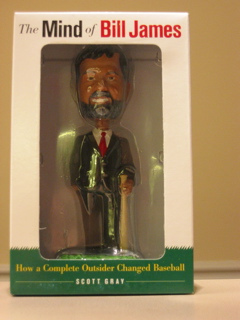
Permalink In the mail today, The Mind of Bill James, How a Complete Outsider Changed Baseball. I've been lucky enough to meet and work with Bill over the years, so I'm looking forward to digesting Scott Gray's look at the Guru. As a bonus, I also received this very cool bobblehead:
I'll keep this one in the box. When Bill is inducted into the Hall of Fame, it might be worth some money. :-) Posted by StatsGuru at 09:00 PM
| Comments (2)
| TrackBack (1)
February 10, 2006
Hacky Stats
Permalink In the mail, Baseball Hacks: Tips & Tools for Analyzing and Winning with Statistics by Joseph Adler. I did a quick skim, and the book is geared for someone who wants to use the internet to collect and analyze baseball statistics. It's chock full of ways to download data from public internet sites, parse the data and store it in a database. It even provides tips for analyzing and displaying the data. It's aimed at the fantasy player, but it would be useful to any sabermetrician. Posted by StatsGuru at 03:02 PM
| Comments (5)
| TrackBack (0)
February 08, 2006
Braves New World
Permalink FoxSports.com posts an excerpt from Dayn Perry's new book, Winners: How Good Baseball Teams Become Great Ones (And It's Not the Way You Think). Dayn focuses on the rise of the Braves in this chapter. Posted by StatsGuru at 07:26 AM
| Comments (1)
| TrackBack (0)
February 07, 2006
Review and Interview
Permalink Bleed Cubbie Blue reviews the soon to be released In the Best Interests of Baseball? and chats with the Author, Andrew Zimbalist. Posted by StatsGuru at 06:27 PM
| Comments (0)
| TrackBack (0)
February 04, 2006
Writing The Book
Permalink Mitchel Litchman, Tangotiger and Andy Dolphin co-authored a new tome on baseball, The Book. Their web site includes excerpts and one of the easiest ordering systems I've used. I've already pre-ordered my copy. Posted by StatsGuru at 09:34 PM
| Comments (1)
| TrackBack (0)
January 10, 2006
The Book on the Padres
Permalink Geoff Young of Ducksnorts offers a 281 page book on the Padres 2005 season for download. It's free, but if you like it consider making a donation. Posted by StatsGuru at 08:05 AM
| Comments (0)
| TrackBack (0)
January 05, 2006
Undoing Myths
Permalink Christina Pazzanese of the Boston Globe reviews The Baseball Uncyclopedia, a humorous attempt to debunk the myths of baseball. Posted by StatsGuru at 08:05 AM
| Comments (1)
| TrackBack (0)
January 01, 2006
Welcome To Fantasy Island
Permalink Steve Lombardi reviews Fantasyland, by Sam Walker. Steve loved the book: Fantasyland is Sam Walker’s chronicle of his first rotisserie baseball experience. However, this is not your everyday fantasy baseball rookie tale. Walker is a sports columnist for the Wall Street Journal who talked his way into joining “Tout Wars” (which is a prominent rotisserie “experts” league) for their 2004 season. Additionally, Sam was armed with a substantial budget – he spent nearly $20,000 traveling and preparing for the league’s player auction – and he decided to employ both a Sabermetrician, Sig Mejdal, and someone who was more focused on the qualitative-side of scouting, Ferdinando (Nando) Di Fino, to assist him through his rotisserie expedition. As such, the debate of Sabermetrics versus traditional scouting (and the balancing of the two schools) is a prevailing thread throughout the book – and in many ways Fantasyland is akin to a good buddy-movie in the way that these three characters (Sam, Sig and Nando) play off each other. It seems Sam got to play fantasy baseball like it was the real thing. He also used his position as a sports writer to influence real life managers to help his team. Sounds like it will be an interesting read. Posted by StatsGuru at 01:55 PM
| Comments (6)
| TrackBack (0)
November 28, 2005
Blogger Books
Permalink Jon Weisman just published The Best of Dodger Thoughts, a compendium of his best posts. I however, like to think his best posts are yet to come. :-) Posted by StatsGuru at 05:31 PM
| Comments (0)
| TrackBack (0)
A Book in the Hand
Permalink Rich Lederer reviews The Bill James Baseball Handbook at Baseball Analysts. Posted by StatsGuru at 08:31 AM
| Comments (0)
| TrackBack (0)
November 04, 2005
Bill James Handbook
Permalink In the mail today is The Bill James Handbook 2006. It's always a treat. Besides the player register, the book supplies complete fielding statistics, pitchers hitting, batters pitching, managers strategies and player projections. One of the more interesting things I saw in my initial skim was in the team efficiency section. It seems that Chicago was the most efficient team in the league in terms of converting runs scored and allowed into wins, while Cleveland was the least efficient. According to the calculations there, the Indians should have won the AL Central by 13 games! One thing in hitter projections seemed wrong to me, however. They project Barry Bonds to hit 36 home runs next year, a very reasonable amount. However, when they project career home runs, they put Bonds at 900. I'm not sure what that is based on, but close to 200 home runs for a player Bonds' age seems very unlikely at this point. I find the park indexes extremely useful during the season. Citizen's bank park in up there with Coors in helping home runs, although it's not that close in overall run scoring. PETCO is the most difficult park for homers and runs by a wide margin. The Bill James Handbook is a great reference. I keep it on my desk the whole season. Posted by StatsGuru at 03:14 PM
| Comments (3)
| TrackBack (0)
September 12, 2005
Annual Hardball
Permalink The Hardball Times Baseball Annual 2006 is now on sale. Order today to ensure you're the first on your block to receive a copy! Posted by StatsGuru at 06:48 PM
| Comments (0)
| TrackBack (0)
August 21, 2005
The Steroid Era
Permalink Alex Belth was kind enough to send along a copy of Juicing the Game by Howard Bryant. I spent many hours on the beach this week with this book, and the read is well worth it. Bryant presents a fairly up-to-date history of latest offensive era and the possible causes; smaller stadiums, tighter baseballs, tiny strike zones and steroids. No one comes out looking very good in the end. First, what I didn't like about the book. While an important story, it's a difficult read. Not only could I put this book down, there were a number of times I had to put it down. Parts captured my attention, and parts were just rehashing old stories that I've heard 100 times. The book could have been shorter and more effective. I also found it somewhat disjointed. One chapter ends with Jeter talking to the press about steroids, denying that he uses them. The press turns to Giambi who is sitting nearby, and Jason also denies using them. It's a powerful moment in the story, given what we've learned in the last year. Instead of following up on this, Bryant totally switches gears and spends a chapter on the strike zone and implosion of the umpires union. I also found the theme of the book difficult to discern. At times it seemed to be an indictment of the long ball era in general. If the same stats had happened without a steroid scandal, Bryant still would have written this book. At times, it's a screed about racism in baseball. Bryant at one point comes very close to blaming racism for Barry Bonds alleged steroid use. But the theme that covers this book the best is that everyone (owners, MLBPA, fans, umpires and the media) wanted offense, and that need forced the game to spin out of control. In the final analysis, however, Bryant gets every angle of the era covered. He documents Bud Selig's ability to take credit for successes and blame everyone else for failures. He shows how the union's insistence on privacy rights ignored the desires of much of the MLBPA membership to fight steroids. He exposes the hypocrisy of Tony La Russa. The manager changed his story on what he knew about steroids to fit the situation. He teaches us that baseball had the ability to test players by invoking a probable cause element of the collective bargaining agreement and never did. La Russa knew Canseco was using steroids and never told his bosses. Even if he had, it's not clear that Sandy Alderson (or any GM or owner) would ask for the test. Baseball hands weren't as tied as they liked to say publicly. He explains to us that the union could have tested players internally, keeping the results totally secret to determine the extent of the problem. The union could even penalize offenders by kicking them out of the MLBPA. They did nothing. He exposes the lack of education on steroids of the men who covered the sport and how people who did try to move the story forward were treated as pariahs. The only people who get treated with kid gloves are the "crusaders," the scientists who are fighting for more testing and harsher penalties. Their views are accepted without the rigorous inspection everyone else receives. Juicing the Game is worth the difficult read. The issues brought forth by Bryant deserve a long discussion. I'll be posting about points of agreement and disagreement with the book in the future. I hope you'll read the book and join the dialog. Posted by StatsGuru at 11:00 AM
| Comments (2)
| TrackBack (0)
July 18, 2005
Wheeling and Dealing
Permalink If you are interested in becoming an independent agent, or if you work for a big agency and want to be your own boss, don't read License to Deal by Jerry Crasnick. Jerry explores the hectic world of the independent agent; the late night calls, the handholding and the betrayal people like Matt Sosnick endure to try to land the prize, a superstar baseball player. I was not enthralled by the story. Crasnick paints Sosnick as a hard driving multi-millionaire who's never achieved happiness because he can't slow down long enough to actually enjoy life. I was bored with this protagonist very early in the book. In fact, the only really interesting character in the story is Dontrelle Willis. Willis comes off as the only flesh and blood human being in the book. Jerry shows us the hard-knock life, the near death experience, the triumph of the draft and Willis' ability to take it all in stride with good humor and generosity. It's a great picture of an emerging major league star, and makes me want to pull for Dontrelle even more. So don't read the book for the story of another super-competitive over achiever. Read it for the story of a pitcher who appreciates every moment of his baseball and personal life. Posted by StatsGuru at 07:22 AM
| Comments (1)
| TrackBack (0)
July 17, 2005
Similarities
Permalink Stephen Lombardi brings us The Baseball Same Game, a fun romp through the history of baseball. He uses comparisons to league averages to find players of similar career lengths and statistics. Some make perfect sense, as Christy Mathewson is paired with Tom Seaver. Some surprise, such as Ralph Garr and Davey Johnson. One that really surprised me was Thurman Munson and Terry Puhl. When we played Strat-o-matic, we called the former outfielder Terry Tool. He was a 1 e0 in right field, the best fielder he could be. He was an A bunter, a B hit and run (both tops) and had great stealing and base running ratings. He seems about as far away from the stocky catcher as you could imagine. But offensively, they were close. Munson had more power, but in terms of runs created, the two were very close. It's one of the examples in the book of Lombardi finding someone (Puhl in this case) who's better than you thought. So pick up a copy of The Baseball Same Game and take a trip down memory lane. You'll meet old friends and make some new ones. Posted by StatsGuru at 01:41 PM
| Comments (0)
| TrackBack (0)
June 14, 2005
General vs. Field Manager
Permalink Benjamin Kabak compares Moneyball and 3 Nights in August. Posted by StatsGuru at 08:24 AM
| Comments (0)
| TrackBack (0)
June 10, 2005
Wheeling and Dealing
Permalink Horsefeathers reviews License to Deal. He likes it very much. I've received a copy and will be reviewing the book soon. Posted by StatsGuru at 07:36 PM
| Comments (0)
| TrackBack (0)
June 03, 2005
The Darkside of the Game
Permalink Eldon Ham's new book Larceny and Old Leather is an amusing collections of stories about how baseball players, owners and teams often bend the rules or outright break them. He covers field manipulation, gambling, curses racism, sign stealing and any other mischief that is part of the lore of the game. The book, however, should be read more as entertainment than fact. In the second paragraph of the first chapter, Ham makes an egregious error, putting Babe Ruth's record setting 59 home runs in 1923 instead of 1921. He also repeats the story about the Black Sox name coming from the White Sox uniforms being dirty, which doesn't appear to be true. This leads me to believe the book is poorly researched. Ham drops the ball in other areas as well. I was looking forward to the chapter titled Hal Chase: Malignant Genius. Chase is one of the darkest characters in the history of baseball. He could have been the model for Senator/Emperor Palpatine in Star Wars, down to the disfigured face. But Ham doesn't explore the character of Chase, nor the reasons for the appellation above; he just attributes it to a judge. Ham is a good story teller, but I'd like more substance. I'd also like to know that he did more than repeat embellished stories, that he actually checked the sources. It appears that didn't happen. Posted by StatsGuru at 03:17 PM
| Comments (5)
| TrackBack (0)
May 16, 2005
Underdogs
Permalink Athletics Nation interviews Michael Lewis about his long term project call Underdogs (Sweet Polly Purebred does not make an appearance). Here's a sample: Blez: You've been around to a lot of the minor league ballparks to see a lot of the kids. What's it like to be a part of that minor league existence, even for just a short little while? I think so many people see the players are the major league level and all the money they make, but they don't see how many kids just struggle at the minor league level and fight to get to where they get to. Posted by StatsGuru at 04:00 PM
| Comments (0)
| TrackBack (0)
May 11, 2005
Economic History
Permalink National Pastime is the latest entry from economics professor Andrew Zimbalist on the game of baseball. He joins forces with fellow economist Stefan Szymanski to explore the economic developments of baseball and soccer, and what each sport may learn from the other. The book is more history lesson than economics lesson, and that was disappointing. The authors are at their best when they are describing why the current scheme of revenue sharing in baseball does not encourage competition, or why the promotion and relegation system of soccer is driving teams into bankruptcy. Zimbalist and Szymanski point out that under the current CBA, teams share 34% of their local revenue. If they spend money to increase their revenue (by signing high priced players), their contributions to the pool increase, but their share of the revenue decrease (since they're making more money). Of course, that might not happen if all teams were attempting to increase revenue, but there is no incentive for that to happen. The authors point out how this works by noting that the Brewers payroll fell while transfers to the team increased between 2001 and 2004. Soccer's economic problems come from the promotion/relegation system, where winning teams can move up to a premier division and losing teams can move down to what is essentially a minor league. With the introduction of satellite broadcasts, competing in the Premier Leagues can be very lucrative for soccer clubs. But in order to gain entry, these clubs will pay high prices to obtain star players often more than they are worth. It's really the same problem low budget teams in the US face; how do you build a team that is good but also doesn't drive you into debt? National Pastime, however, does not go looking for the Billy Beane of soccer. Szymanski and Zimbalist in the end believe that soccer could benefit from baseball's closed monopoly system, and basebal could benefit from a soccer like governing body outside the league and committed to the long term growth of the game. However, they're solutions are not very specific. How should soccer insure the solvency of teams? Why should baseball owners give up their rights to a strong central leader? The book would have been better with more economics and less history. It would also have been interesting to include other views; for example, are there no economists arguing for a totally free market approach, where teams are free to form leagues for a given amount of time and players are free to move between teams at the end of their contracts? National Pastime does a good job of identifying problems, but it left me hungry for more solutions. Posted by StatsGuru at 10:10 AM
| Comments (2)
| TrackBack (0)
April 29, 2005
Cheating Hearts
Permalink In the mail today was Larceny and Old Leather by Eldon Ham. It looks at the mischievous legacy of major league baseball. I'll be reviewing this book soon. Posted by StatsGuru at 11:20 AM
| Comments (0)
| TrackBack (0)
April 28, 2005
Pastimes
Permalink In the mail today, National Pastime by Stefan Szymanski and Andrew Zimbalist. It's a look at the business of Baseball in the US and soccer in the rest of the world. I'll have a review after I've read the book. Posted by StatsGuru at 02:31 PM
| Comments (0)
| TrackBack (0)
March 29, 2005
Tony Time
Permalink NPR's Morning edition had an interview with Tony La Russa and Buzz Bissinger, the author of the new book Three Nights. Three Nights explores the managing style of La Russa. At the web page for the story you can hear the interview as well as listen to excerpts that didn't make air. There's also a powerful excerpt from the book about the death of Darryl Kile.
Posted by StatsGuru at 09:46 AM
| Comments (1)
| TrackBack (1)
March 20, 2005
Dice and Cards
Permalink Long time readers of this blog know I'm a fan of Strat-O-Matic baseball. I've been playing in leagues on and off since college, both face to face and by mail. When Strat-O-Matic Fanatics arrived in the mail recently, I thought it would be an interesting read about people like me, fans who learned to appreciate the game statistically through simulation. It turned out to be much more than that. Author Glenn Guzzo brings us the intimate details of the life of Hal Richman, the inventor of the game. Trapped in a dysfunctional family, Hal's love of sports becomes his escape. The lack of statistical accuracy of All Star Baseball prompts Hal to invent his own game at age 12, the game that would evolve into Strat-O-Matic, the game that would give him independence from his family. It's the story of the underdog becoming the hero through hard work and honesty. Guzzo tells the tale well, invoking sympathy for Hal's pain and happiness for his triumph. Along the way, any Strat player will see a bit of himself in the people who play the game; pouring over cards, rolling the dice. Guzzo captures the exciement of turning over a split card to see if the result is a hit or an out. Of course, we meet the famous players. Dan Okrent of the NY Times and the inventor of fantasy baseball. John Miller, the voice of Sunday Night Baseball on ESPN. Lenny Dykstra of the Mets and Phillies. Guzzo takes us behind the scenes of ratings meetings and touraments. But in the end, it's the story of Hal Richman and his fights throught adversity that make this book a must read.
Posted by StatsGuru at 02:57 PM
| Comments (1)
| TrackBack (0)
March 17, 2005
Clubbing
Permalink Batgirl has announced her next read in her book club: Moneyball. I'll have to join that discussion. She also reproduces (without linking, and I can't find it) an article about the Blue Jays abandoning the supposed Moneyball offense (get on base, hit home runs) for the agreesive Twins offense (don't get on base but run really fast). The article is based on criticism in the 2005 Baseball Prospectus.
Posted by StatsGuru at 09:51 AM
| Comments (1)
| TrackBack (1)
March 04, 2005
Juicy Review
Permalink Evan Brunell has a lengthy and thoughtful review of Jose Canseco's book, Juiced: Wild Times, Rampant ‘Roids, Smash Hits, and How Baseball Got Big at Firebrand of the American League. The bottom line: I believe Jose Canseco. I agree that the mistakes in the book have more to do with memory slips and the lack of fact checking by the ghost writer than outright lies. However, bad facts do lead to a lack of credibility. So why does Evan believe him? We all believe Giambi used. I’ve seen pictures of Ivan when he broke in, right before Jose arrived, pre-Jose, and now current Ivan. He used. I’ve seen Juan Gonzalez and I believe it. Palmiero is a little iffy for me, because I don’t really recall Palmiero being incredibly skinny. I don’t think he completely relied on steroids, but could he use a low base of steroids to help? Of course. Barry Bonds? Yeah. He used, same for Gary Sheffield. How about Bret Boone? Obviously. Sammy Sosa, I agree. Even the implication of Miguel Tejada goes a little far but is nonetheless, still believable. The whole review is well worth the read. Others believe Canseco as well, but few are as sympathetic towards him.
Posted by StatsGuru at 09:05 AM
| Comments (0)
| TrackBack (0)
March 01, 2005
Bullpens by the Book
Permalink The good people at The Hardball Times have produced their second publication, The Bullpen Book. I received my copy today and will be offering a review soon. Baseball Musings is holding a pledge drive during March. Click here for details. Posted by StatsGuru at 12:34 PM
| Comments (0)
| TrackBack (0)
February 18, 2005
Steroid Books
Permalink Like Blez at Atheltics Nation, I visited a bookstore yesterday. I thought about buying Canseco's book, when Testosterone Dreams caught my eye. I bought that instead, and so far it's a very interesting read. While you might want to read Jose's book for the controversy, Testosterone Dreams may teach you a lot more of the history of these drugs. I hope to post a review when I'm done. Posted by StatsGuru at 10:10 AM
| Comments (0)
| TrackBack (0)
Scouts Revenge
Permalink Sabernomics posts on the new book, Scouts Honor. It's being touted as the anti-Moneyball. The book's web page states that "SCOUT'S HONOR has the support of upper management in 80% of the MLB teams in the country." My guess is that the six teams that don't support the book are the Red Sox, Athletics, Dodgers, Padres, Blue Jays and one of (Indians/Yankees/Rangers/Cardinals). It should be a very interesting read. Posted by StatsGuru at 09:55 AM
| Comments (8)
| TrackBack (0)
February 14, 2005
Questioning Canseco
Permalink Will Carroll has read Jose Canseco's book and seen the 60-minutes interview (I have done neither). Will has some good questions for Jose, especially this one: 2. How did you get access to hGH in 1985, just as it became available to the public as Humatrope? At an estimated cost of $30,000 for a therapeutic dose (presumably much smaller than used for performance enhancement), why would he share it? Also, check out Will's article on Yes where he fact checks the book as much as he's able. Posted by StatsGuru at 06:53 PM
| Comments (14)
| TrackBack (2)
December 07, 2004
Capitol Trivia
Permalink I just received The Ultimate Washington Baseball Trivia Book in the mail today. David Elfin is a veteran sports writer for the Washington Times and a fan of the late expansion Senators. He uses triva, photos and brief player biographies to tell the history of major league baseball in the nation's capitol. Each trivia page has 9 questions (one for each inning) around a theme such as Three Baggers or The Presidents. Did you know that Jimmy Carter is the only president from Taft on not to throw out a first pitch anywhere? It's a fun book to learn about the history of the city's teams with the Expos moving to DC in 2005. However, the book does look hastily published; there are a number of typos in the prose. But this inexpensive paperback would make a great stocking stuffer for the young Washington fan unfamilar with his city's baseball heritage. Enjoy! Posted by StatsGuru at 08:40 PM
| Comments (2)
| TrackBack (0)
November 12, 2004
Book in the Mail
Permalink My copy of the Bill James Handbook 2005 arrived in the mail today. Although I worked on the publication, this is the first time I've seen the finished product, and the first time I've seen the Bill James sections of the book. If you are a fan of the Abstracts, you'll want to pick a copy up to see how and why Bill has updated the runs created formula. He has a whole section on efficient teams that came from the realization that the Red Sox have been an inefficient team for nearly two decades. In trying to figure out why, Bill revised the runs created formula by adjusting the advancement part of the formula, making the weights for hits non-integer. This has the nice effect of making the formula more accurate for teams going back to 1955. One of the other new sections is by Sig Mejdal. Sig is a biomathematician who works for NASA (not a rocket scientist, but close). Sig is doing extremely interesting work using stepwise logistic time series regression to try to determine the probability of a player being injured given his history and body type. I hope interview Sig about his work more over the winter. If you're interested, follow the link above to purchase a copy. You won't be disappointed. Posted by StatsGuru at 03:05 PM
| Comments (3)
| TrackBack (0)
November 09, 2004
Hardball Times Annual
Permalink The Hardball Times is going from pixels to paper with The 2004 Hardball Times Baseball Annual. I'm sure the book will be as interesting as the site. And if you like pixels better than paper, you can download the publication for very little money. I'll have a review when I get my copy. Posted by StatsGuru at 10:00 AM
| TrackBack (0)
October 18, 2004
More Shameless Plugs
Permalink I've been busy the last two weeks working with the terrific crew at Baseball Info Solutions helping to put together The Bill James Handbook: 2005. It's a great resource for your fantasy scouting. The book also allows you to spend the winter exploring players in depth, since
There also are statistics that look at managerial strategy, win shares, lefty/righty and new material from Bill James. Order now so it's on your self Nov. 1. Baseball Info Solutions now has season final and lefty/righty stats available for download. Just stop by our store and pick up what you need! Posted by StatsGuru at 02:35 PM
| Comments (1)
| TrackBack (0)
September 14, 2004
Shameless Plug
Permalink Baseball Info Solutions is now taking orders for The Bill James Handbook: 2005. The book will be available November 1 and is a great winter time companion. It's the first book every year to have the complete career records of the season's players, lefty-righty matchups, leader boards galore, and other interesting stats and studies. Reserve yours today, and be the first on your block to scout your fantasy team for next season! Posted by StatsGuru at 11:30 PM
| Comments (1)
| TrackBack (0)
August 28, 2004
Summer Reading
Permalink One nice thing about vacations for me is that I get to catch up on some reading. I've had Curve Ball by Jim Albert and Jay Bennett sitting on my shelf for some time, and found it a very good book on explaining baseball statistics using statistical models. I like their method of predicting Sammy Sosa's HR totals. Their best guess for Sosa through age 32 was 438 HR; he had 448. Through age 34 it was 527; he had 537. (In the book, they had 2 year intervals). For age 36, the end of next year, they have Sosa at 597, with a 48% chance of being over 600. We'll see. In general, the book confirmed a number of methods I've used for analysis over the years. I recommend it to anyone interested in methods of testing speculation with mathematics. The other baseball related book I had a chance to digest was The Teammates by David Halberstam. It's the story of the long-time friendship between Ted Williams, Dom DiMaggio, John Pesky and Bobby Doerr. I came away wanting a detailed biography of Dom DiMaggio, certainly the most interesting of the brothers as a person. It's short, well-written and worth the read not only to explore the lives to these men, but as a reminder of what baseball was like in the 30's and 40's. Posted by StatsGuru at 05:54 PM
| Comments (1)
| TrackBack (0)
August 20, 2004
Building the Yankees
Permalink Alex Belth has a excerpt from Buster Olney's The Last Night of the Yankees Dynasty at Bronx Banter. The excerpt focuses on how Gene Michael and Buck Showalter laid the foundation for the dynasty that continues today. An excellent read. Posted by StatsGuru at 11:33 AM
| TrackBack (0)
August 13, 2004
Don't Like the Yankees
Permalink Jim Gerard sends this E-Mail:
I don't care of the title, but it sounds like an interesting approach to gathering opinions. So if you'd like to help out and express yours, feel free to do so in the comments. This post doesn't really answer the question, but it does offer an explanation for the Red Sox inferiority complex. Posted by StatsGuru at 05:16 PM
| Comments (18)
| TrackBack (0)
June 15, 2004
Fastballs
Permalink ESPN.com has an excerpt from the Neyer/James Guide to Pitchers, discussing the fastball. Posted by StatsGuru at 02:11 PM
| TrackBack (0)
May 06, 2004
Will Kevin Costner Play Beane?
Permalink Michael Katz sends this link. Hollywood is thinking of turning Moneyball into a movie. Hooray for Hollywood! Posted by StatsGuru at 05:18 PM
| Comments (4)
| TrackBack (0)
March 26, 2004
Green Monster Mile
Permalink Baseball Widow reports that Stephen King will be chronicling the 2004 Boston Red Sox. As Count Floyd would say, "EEEW!, That's scary stuff!" Posted by StatsGuru at 08:18 AM
| Comments (3)
| TrackBack (0)
March 21, 2004
Book Plug
Permalink Will Carroll has a new book coming out, Saving the Pitcher. You can pre-order it at the above link. Will tells me he's looking to do clinics around the release of the book, so be sure to look for those. Posted by StatsGuru at 12:07 PM
| Comments (1)
| TrackBack (0)
January 22, 2004
Baseball and Music
Permalink Bill Hobbs sends me this review of Baseball and Country Music. Posted by StatsGuru at 11:30 AM
| Comments (3)
| TrackBack (0)
January 06, 2004
Rose Review
Permalink Alysse Minkoff of ESPN.com Page 2 has read My Prison Without Bars and liked it a great deal.
Posted by StatsGuru at 09:57 PM
| Comments (1)
| TrackBack (0)
December 17, 2003
January Bloom?
Permalink William Kelly alerted me to the latest Rob Neyer column, which has its most interesting material at the bottom:
Mark your calendars. Posted by StatsGuru at 02:44 PM
| Comments (7)
| TrackBack (0)
December 11, 2003
Bill James Handbook
Permalink Rich Lederer has a review of the 2004 Bill James Handbook, with lots of great tidbits pulled from the pages. I would like to correct one misconception Rich has, however:
This book replaced the Major League Handbook published for many years by STATS, Inc., and is not meant to replace the old Abstracts or other research books by Bill James. Posted by StatsGuru at 09:27 AM
| Comments (3)
| TrackBack (0)
December 08, 2003
On the Money
Permalink Matt Welch, one of my favorite bloggers, offers this review of Moneyball in Reason Online.
Posted by StatsGuru at 04:43 PM
| Comments (1)
| TrackBack (0)
November 14, 2003
Handbook Returns
Permalink Peter Gammons likes the new Bill James Handbook, replacing the old one that STATS, Inc. used to publish. You can purchase a copy here. Posted by StatsGuru at 09:48 AM
| TrackBack (0)
July 21, 2003
New Baseball Book
Permalink Sean Kirst, a columnist with the Post-Standard in Syracuse, NY, has written a book of baseball essays entitled, The Ashes of Lou Gehrig. He sent me a sample essay on patch jackets, which I just loved. When it's published, I'm looking forward to reading the whole thing. Here's an excerpt: Posted by StatsGuru at 07:29 PM
| TrackBack (0)
July 10, 2003
Larry Dierker
Permalink Dr. Manhattan alerted me to this post, based on this Rob Neyer interview with Larry Dieker. I'd like to comment on both. First on the Neyer interview. Larry Dieker has written a book in which he discusses his life in baseball. It turns out Dieker is a fine writer and a sabremetrician to boot. But he also talks about balancing his desire to do the mathematically correct thing with doing what the players expect of him:
This is actually the right way to do things. Being a manager has two aspects; you have to manager a game, but you have to manage people, too. Davy Johnson was great at the game, but he lacked in managing people. Joe Torre's not that great at the game, but he's fantastic at the people side. Both can work, given the right team. Dieker, to his credit, tried to do both well. I'm looking forward to reading his book. Dr. Manhattan at Blissful Knowledge brings this column over to Moneyball and the A's, asking:
Now, for some reason, I thought the answer would be Dieker. But no, Dr. Manhattan has another idea:
I think this would be a terrible move. There is a reason good-cop/bad-cop works. People need an alternative point of view. If you put Valentine in charge of the A's, you'd have bad-cop/bad-cop, and that would be just too much intimidation. You need the guy who can call the star who just got chewed out by the GM into his office and say, "Yeah, he's a jerk, but he pays our salaries. Let's try it his way for a while and see if we win." Secondly, Beane wants people who come cheap, and Valentine would not come cheap. Posted by StatsGuru at 09:29 AM
| TrackBack (1)
June 23, 2003
Moneyball
Permalink I just finished reading Moneyball by Michael Lewis. I enjoyed the book throughly, despite the obsenities. Lewis understands exactly what Beane is doing. He understands because, like many of us, he read Bill James and appreciated Bill James in the 1980's. Most of the time I was reading I was saying to myself, "I knew that 20 years ago. Why don't teams realize the truth of what's going on?" This book makes me want to be a GM. What Beane is doing was obvious to me back when the new labor deal was signed after the 1994 strike. All I heard from people after that contract was there was no way poor teams could compete. You had to have money to compete. I would say, "That's not true. There's more than one way to win at baseball. Someone will find a way to win with young players who aren't paid that much. It may take a few years for a team to figure it out, but some team will." No one believed me. Even when the A's started winning, no one believed me. But by the end of that contract, the A's had figured it out. The Twins, in a different way, figured it out. The Blue Jays have figured it out, and the Red Sox are figuring it out. I suspect Pittsburgh is figuring it out. I'd love to be GM of KC or Detroit or Montreal and do what Beane has done. I'd love to be the GM of a little independent league team and pull these overlooked players out of college, develop them, and sell them to the majors. Beane has taken Bill James and put him to practical use, and it works. I'd love to give it a try. Posted by StatsGuru at 09:24 PM
| TrackBack (0)
June 20, 2003
Foul Ball
Permalink Jim Bouton has a new book about trying to save Wahconah Park in Pittsfield, Massachusetts. If you are interested, he'll be signing books at the Barnes and Noble in Holyoke Massachusetts on June 28th at 11 AM. Posted by StatsGuru at 08:59 PM
| TrackBack (0)
June 12, 2003
Moneyball Replies
Permalink I've gotten a few replies to my inquiries on Moneyball and I'd like to share them with you. From Daniel:
This from M. Lee Murrah:
And finally, Peter Patton:
Thanks! Posted by StatsGuru at 02:08 PM
| TrackBack (0)
May 26, 2003
Moneyball Review
Permalink Dr. Manhattan has his take on Moneyball over at Blissful Knowledge. Posted by StatsGuru at 09:05 AM
| TrackBack (0)
May 16, 2003
Moneyball
Permalink Alex Belth has a review of Moneyball over at Bronx Banter. Notice: the review contains quotes from the book that use obscenities. I really don't like this trend in writing. I first noticed it when Tina Brown took over the New Yorker. You couldn't read an issue without seeing the F-word. It started out being in quotes from people, but has lately become (as in the passage from Moneyball) part of the prose. I find no excuse for an author using this word outside of dialog. I feel that writing is supposed to elevate language. Alex Belth calls Michael Lewis' book smart. Really smart people have a large enough vocabulary to avoid the use of obscenities. Posted by StatsGuru at 07:17 AM
| TrackBack (0)
|
Navigation
EMail
Home About the Author Dedication Baseball Musings Radio Show Sporting News Columns Day by Day Database Lineup Analysis Defensive Charts, Probabilistic Model of Range Syndicate this site:  Full post feed: Robot Podcast Feed Terms of Service Mitchell & Ness Throwback Jerseys
View blog authority
Tickets and Other Links
Buy MLB Baseball tickets online including Boston Red Sox tickets, New York Yankees tickets, Baltimore Orioles tickets, Chicago Cubs tickets, San Francisco Giants tickets, Washington Nationals tickets, Los Angles Dodgers tickets, Florida Marlins tickets. San Diego Padres tickets, Cardinals box seats and premium astros tickets. We also carry concert tickets and theater tickets.
MLB Baseball Baltimore Orioles Tickets Boston Red Sox Tickets Chicago Cubs Tickets Chicago White Sox Tickets Houston Astros Tickets LA Dodgers Tickets New York Yankees Tickets Washington Nationals Tickets and St Louis Cardinals Tickets GET ME IN! is the leading marketplace for: Sports Tickets Football Tickets Rugby Union Tickets Rugby League Tickets Hong Kong Sevens Tickets MotoGP Tickets Grand Prix Tickets NBA Tickets NFL Tickets Theatre Tickets and Concert Tickets Ticketamerica.com MLB Tickets Chicago Cubs Cincinnati Reds Houston Astros Milwaukee Brewers Pittsburgh Pirates St. Louis Cardinals Boston Red Sox New York Yankees Tampa Bay Devil Rays Premiership football tickets FA cup tickets Champions league tickets Football tickets Olympics tickets Super Media Blog
Calendar
Recent Entries
New RSS Feed
New Look Coming Team Offense, Arizona Diamondbacks Lastings Impression Pledge Drive Update Long Term Lester Stadium Pictures Lugo and Lowrie Pledge Drive Update Team Offense, Pittsburgh Pirates
Search
Archives
By Category:
Advertising (10) Agents (12) All-Star Game (173) All-Time Greats (239) Army Strong (8) Attendance (174) Authors (3) Awards (169) Base Running (78) Baseball (1581) Baseball Jerks (219) Blogs (759) Books (129) Broadcasts (568) Charity (49) Cheating (665) Collectibles (15) College (1) Colleges (3) Commissioner (40) Conditioning (1) Contests (10) Crime (100) Cuba (1) Deaths (169) Defense (372) Demographics (8) Discipline (12) Division Races (724) Draft (63) Equipment (25) Fan Rant (46) Fan Violence (10) Fans (58) Fantasy Baseball (38) Feats (3) Films (3) Free Agents (782) Games (5549) History (102) Hit Streaks (22) Humor (64) Ice Cream (4) Illnesses (135) Independent Leagues (16) Infrastructure (3) Injuries (1122) International (76) Interviews (168) League Championship Series (1170) League Division Series (923) Little League (2) Management (1281) Mascots (4) Matchups (698) Mechandising (46) Minor Leagues (12) Movies (9) News Media (96) Oddities (1) Offense (216) Old Timers (4) On Base (18) Opening Day (210) Opening Day Impressions (19) Other (321) Owners (73) Pennant Races (32) Pitchers (2911) Players (1524) Podcasts (185) Post Season (59) Power Hitting (5) Pranks (1) Predictions (145) Probabilistic Model of Range (108) Public Relations (8) Records (153) Rivals (2) Rookies (44) Rules (25) Salaries (12) Scheduling (22) Science (1) Scoring (5) Series (61) Simulations (5) Sluggers (752) Spring Training (117) Stadiums (279) Standings (25) Statistics (996) steroids (1) Strategy (171) Streaks (14) Superstitions (16) Team Evaluation (937) Team Movements (58) Tickets (56) Trades (700) Transactions (321) Umpires (53) Uniforms (17) Union (22) Welcome! (3) women (4) World Cup (170) World Series (657) By Month: March 2009 February 2009 January 2009 December 2008 November 2008 October 2008 September 2008 August 2008 July 2008 June 2008 May 2008 April 2008 March 2008 February 2008 January 2008 December 2007 November 2007 October 2007 September 2007 August 2007 July 2007 June 2007 May 2007 April 2007 March 2007 February 2007 January 2007 December 2006 November 2006 October 2006 September 2006 August 2006 July 2006 June 2006 May 2006 April 2006 March 2006 February 2006 January 2006 December 2005 November 2005 October 2005 September 2005 August 2005 July 2005 June 2005 May 2005 April 2005 March 2005 February 2005 January 2005 December 2004 November 2004 October 2004 September 2004 August 2004 July 2004 June 2004 May 2004 April 2004 March 2004 February 2004 January 2004 December 2003 November 2003 October 2003 September 2003 August 2003 July 2003 June 2003 May 2003 April 2003 March 2003 February 2003 January 2003 December 2002 November 2002 October 2002 September 2002 August 2002 July 2002 June 2002 May 2002 April 2002 March 2002
Credits
  

|
||||||||||||||||||||||||||||||||||||||||||||
 . The Boston Globe
  . He praises Tom Verducci's writing:
 is ready to order. That of course reminds me you may want to stock up on your baseball books, like
  and
and  .
. .
. in the mail. The author, Tony Verna tells the story of how he conceived of and executed the first instant replay
  is now shipping.
 , at the West Hartford Public Library on Tuesday, Oct. 28, 2008 at 7 PM. You can read more about the book and find out more about their promotions at the
  . Here is their story:
 . By luck, I opened to the chapter on rowing. I was a coxswain in college, so I identified with this:
 presents Rob Neyer at his best. My first exposure to Rob's work came from his contributions to Bill James's Baseball Books, where Neyer wrote sidebars tracking down these types of stories. Now with Retrosheet at his disposal, Rob can do even better work. He tracks down home run banter between Fred Haney and Babe Ruth. He discovers if Munson dropped third strikes so he could pull ahead of Fisk in assists. He examines bean balls and Bob Feller's wildness.
 . Jonathan Eig presents a narrative tough to put down. I like to skim books to get a feel for the story, but I found myself reading page after page and letting the time slip away.
 looks like a lot of fun. Just skimming through the book I came across the illustrations of how doctored pitches move. Given the ugliness of the substances on the balls, I'm glad I never caught Gaylord Perry. The author, Derek Zumsteg, can be read on a daily basis at
  . I've heard about this movie for a few years but never got the chance to see it in a theater. I'm a huge fan of
  . My roommate Jim Storer and I used to go see the movie whenever it played at the old Harvard Square Theater (for $2, you saw classic double features). One night we went and the movie was sold out, so we walked around reciting lines to entertain ourselves. I still say, "the universe is expanding," when I find someone worrying about something frivolous. I'll post a review of Burning Annie just for fun after I see the film.
 arrived in the mail. Dennis Purdy offers tons of various baseball trivia questions from records to movie quotes. My favorites are the pictures to identify. Even baseball experts will find this book challenging.
 by Alan Byrd provides all the information a traveler to Florida needs to navigate spring training baseball. Alan attended games at each stadium and gives you a real feel for what the ballpark is like. He lists the pros and cons, the beautiful and the ugly. For each park, a general introduction is followed by specifics on everything from, food to shade to how to exit the parking lot quickly. He tells you where it's easy to get autographs, where to stay in the area, and where to get food or drink before and after the game.
  . (Also in Spanish,
  ) The story line sounds familiar:
 is available from Amazon and
  yesterday. The first thing that caught my eye was the voting for best defensive players. Bill gathered a panel of experts from both the news media and the sabermetric world, gave them ballots and had them vote in a Borda count. What's interesting is there is a lot of agreement with the
  by JC Bradbury, author of
  . Brad Snyder spends a few chapters on Flood's biography, but the bulk of the story is devoted to Flood's court battle. If you're interested in a more complete biography of Flood, I'd recommend
  by Bronx Banter blogger Alex Belth.