 |
 |
|
| |||||||||||||||||||||||||||||||||||||||||||||
|
March 07, 2009
MIT Technology in Sports
Permalink I'm trying a different panel this time, one that talks about technology in developing equipment. On the panel are Dr. Mike Caine of Loughborough U., Paul Litchefield of Reebok, Steve Solomom of Accrue Sports Entertainment Ventures, Dick Rugge of the USGA and Mike Leigh of the US Olympic Committee. Dr. Kim Blair of Sports Innovation Group LLC moderates. Steve Solomon worked for the people who came up with the glowing puck, K-Zone, and the virtual first down lines in football. 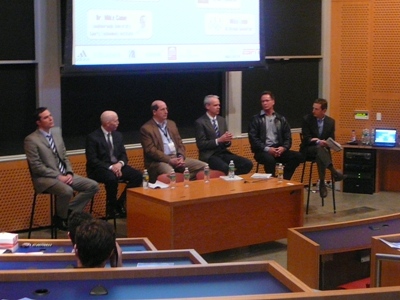
Caine, Litchfield, Solomon, Rugge, Leigh, Blair Update: Rugge's job is to make sure technology doesn't overcome individual skill in golf. Update: Mike Leigh made the point that technology helped older Olympians stay in the game and compete successfully. Update: Mike Caine notes that we can now equip balls with chips that tell us more about what's going on in the game. Update: Solomon notes that broadband allows low level sports (such as high school) to be available for viewing. In the aggregate, the market is huge, but it would never make it in the traditional broadcast market as a business. Update: Leigh is looking for a way to get an edge in sliding events at the Olympics. You can't heat runners on sleds, so he's wondering if there is a way to transfer heat during the event. He's looking to bend the rules to get an edge. Update: Dr. Caine used the term technological doping, that he sees as inflammatory. Update: I got in a question, can technology replace umpires? Dr. Caine says yes, but thinks that human judgement is part of the game and should remain so. Leigh brings up the point that this technology can be used to help the umpire, for example, telling him that the ball was over the plate. Steve Solomon wondered, however, if fans really want strike zones called to the rule book. Posted by StatsGuru at 01:37 PM
| Comments (0)
| TrackBack (0)
January 21, 2009
Bat Wars
Permalink Rumors on the Internets publishes the obscenity laced tirade one small bat manufacturer emailed to baseball over new bat regulations. The blogger takes an in-depth look at MLB's research on bats and how they appear to be trying to drive out the start ups in the bat business. A great post well worth the read. Posted by StatsGuru at 02:04 PM
| Comments (1)
| TrackBack (0)
December 09, 2008
Delta Y/Delta X
Permalink New guidelines for bat manufacturers concern the slope of grain. Posted by StatsGuru at 11:08 PM
| Comments (1)
| TrackBack (0)
December 08, 2008
Maple Reprieve
Permalink Maple bats will remain in use in Major League Baseball: After a season in which jagged chunks of broken maple bats flew across the infield and into the stands in epidemic proportions, Major League Baseball will announce Tuesday that it will not ban the bats. That's good. I wonder if this will force players to use thicker handles? Hat tip to 6-4-2. Posted by StatsGuru at 06:07 PM
| Comments (2)
| TrackBack (0)
September 11, 2008
Broken Bat Problem
Permalink Dex at Gaslamp Ball proposes a simple solution to the maple bat breaking problem. Posted by StatsGuru at 01:09 PM
| Comments (2)
| TrackBack (0)
August 26, 2008
New Bat Time, New Bat Channel
Permalink An MIT graduate figured out how to make a wood bat that competes with aluminum models in durability. It is made from 12 wedges that are combined with adhesive and clamping pressure. The result is that the outside of each wedge has a tight grain surface, guaranteeing the best hitting surface at every spot on the bat. The bat is expensive, but if it lasts longer and saves some people from injury, it just might be worth it. Posted by StatsGuru at 07:55 PM
| Comments (0)
| TrackBack (0)
June 25, 2008
Rounding up the Bats
Permalink Peter Abraham comes down clearly on banning maple bats, joining others in a growing chorus. This reminds me of something Bill James suggested as a way to improve the game. The league should standardize equipment. James suggested that everyone use the same size bat. Rather than individual models each bat would be built to the same specifications. This would prevent a player from gaining a technological advantage, and might also prevent what seems to be happening with maple bats. Posted by StatsGuru at 12:45 PM
| Comments (15)
| TrackBack (0)
May 30, 2008
Sweet Spot
Permalink Luke Scott gives Tyler Kepner a visual lesson on the sweet spot. Posted by StatsGuru at 11:23 AM
| Comments (1)
| TrackBack (0)
April 17, 2008
Sam Endorsement
Permalink Sam Bats received a ringing endorsement from Mariano Rivera: Several years ago, Holman was in Tampa to visit with one of his clients, Alfonso Soriano, the former Yankee. Holman, who usually talks with hitters, found himself in a conversation with Rivera. Mariano is famous for breaking bats with his appropriately named cutter. I guess he can't break the maple sticks. Posted by StatsGuru at 08:16 PM
| Comments (0)
| TrackBack (0)
January 09, 2008
Breaking Bats
Permalink Via my lovely wife Marilyn, Bill Nye on why baseball bats break. Posted by StatsGuru at 11:37 AM
| Comments (1)
| TrackBack (0)
December 10, 2007
Iron Balls Littell
Permalink Mark Littell invented a new protective cup call the Nutty Buddy. I'm still in pain after watching the video, but the device does appear to offer complete protection. Posted by StatsGuru at 08:07 AM
| Comments (1)
| TrackBack (0)
May 28, 2007
All You Need is Glove
Permalink BaseballGloves.com now sports a page that tells you the manufacturer of gloves for various major league players. Posted by StatsGuru at 08:44 PM
| Comments (0)
| TrackBack (0)
March 13, 2007
Wood or Not?
Permalink Kevin Kernan explores the reasons Little League is opposed to a ban on non-wood bats. • More than 10 years ago, the major manufacturers of non-wood bats reached an agreement with Little League to limit their bats to a "Bat Performance Factor" (BPF) of 1.15. ... The BPF is essentially a measure of a non-wood bat's performance (how fast the ball exits the bat when hit) in relation to a standard wood bat's rating of 1.00. A very good wood bat's BPF is 1.15. The article goes on to point out that even though the bats are swung faster than aluminum, the transfer of momentum is less. I personally like wooden bats better, since that's what you use in the pros. I understand the costs, however, but according to little leagues, injuries isn't one of them. The whole post is well worth the read. Posted by StatsGuru at 11:44 AM
| Comments (1)
| TrackBack (0)
February 11, 2007
The Coors Report
Permalink I was hoping someone would attend the SABR meeting in Denver yesterday, and Dan Fox did. He pens this excellent report on the meeting, including information about the humidor, or the environmental chamber as the Rockies like to call it: Finally, Walter Sylvester, who works in the Baseball Operations department for the Rockies, was introduced and opened the floor to questions from the group. In answering one question he noted that a sample of balls are tested when they come out of the chamber to ensure they still meet specifications with the ones that fail the test being used for batting practice. He also opined that he thought that eventually bats may come under the same scrutiny as baseballs and that he thought that the baseballs used in the bullpens by pitchers also come from the chamber (which makes sense since a pitcher warming up should use baseballs that are as close to those used in the game as possible). Thanks for the reporting, Dan! Posted by StatsGuru at 05:15 PM
| Comments (0)
| TrackBack (0)
February 09, 2007
Keeping Cool
Permalink Major League Baseball ordered teams to keep their game balls at 70 degrees Farenheit this season: The commissioner's office is telling teams for the first time that balls must be stored at a uniform temperature after they are delivered from the manufacturer. It's the Coors effect: The decision was made following debate generated by the Colorado Rockies' use of a humidor at Coors Field. The ballpark ranked first in the major leagues in scoring in its first eight seasons, starting in 1995, but dropped to second in three of the last four years behind Arlington's Ameriquest Field (2003), Cincinnati's Great American Ball Park (2005) and Kansas City's Kauffman Stadium (2006). There's going to be a meeting of SABR in Denver tomorrow discussing this issue. If any Baseball Musings readers go, feel free to write something up and send it in. However, what happens when a team is playing in 40 degree weather in April? Is MLB concerned about shrinkage? Posted by StatsGuru at 07:58 PM
| Comments (0)
| TrackBack (0)
January 03, 2007
Juicing the Ball
Permalink A company that specializes in imaging claims that 1998 balls were juiced, including the ball McGwire hit for home run #70. "Examining the CT images of Mark McGwire's 70th home run ball one can clearly see the synthetic ring around the core - or 'pill' - of the baseball," UMS president David Zavagno said. "While Mark McGwire may or may not have used illegal steroids, the evidence shows his ball - under the governing body of the league - was juiced." Universal Medical Systems make veterinary scanners. If they have comparative pictures of 1998 and other baseballs, they should post them on the web so everyone can see. Update: John Costello sent me an e-mail about this earlier today but it got dumped in my junk mail folder. He sends a link with images. However, there are no non-1998 balls for comparison. Posted by StatsGuru at 09:36 PM
| Comments (6)
| TrackBack (0)
December 14, 2006
Robo-Rod
Permalink Deadspin posts video of a robot hitter. I like the way it just tries to make contact. Posted by StatsGuru at 06:53 PM
| Comments (6)
| TrackBack (0)
November 24, 2006
Bats for Sale
Permalink Are you interested in getting into the bat making business? A premier bat making operation is for sale. Posted by StatsGuru at 09:34 AM
| Comments (0)
| TrackBack (0)
October 18, 2006
Bat Man
Permalink Popular Mechanics profiles Andy Byrnes, one of the people who manufacture the Sam Bat. Posted by StatsGuru at 03:27 PM
| Comments (0)
| TrackBack (0)
April 24, 2006
Filling Bigger Shoes
Permalink Kevin Mench's foot was bothering him. The answer: bigger shoes. It's gotta be the shoes. This reminds me of the Mike Venafro story from spring training. Do players skimp on their playing shoes? I mean, if I were a player, I'd be paying for custom cleats that fit just right. Is it that they are so anxious to get freebies from the apparel companies that they don't bother to make sure the shoes are actually right for them? It seems to me that it would be worth it for a player to spend a few thousand dollars on proper footwear. It's an important part of their equipment. Posted by StatsGuru at 09:15 AM
| Comments (5)
| TrackBack (0)
February 15, 2006
New Tee?
Permalink The New York Daily News posts an article about Jorge Posada wishing to catch Randy Johnson, but the picture next to the article caught my attention. Posada is hitting off a batting tee that suspends the ball with jets of air. Way cool. Update: The New York Times has a picture from a different angle. Posted by StatsGuru at 09:01 AM
| Comments (5)
| TrackBack (0)
July 27, 2005
Knobs on Bats
Permalink This post made David Singer want to ask for clarification on who invented knobs on the end of baseball bats. If you can help him, leave on comment at his blog. Posted by StatsGuru at 04:29 PM
| Comments (1)
| TrackBack (0)
Bigger Bats
Permalink Jim Caple takes replicas of vintage bats to ballparks to see the reactions of hitters. We gave our brother-in-law a 1927 Babe Ruth replica bat for his 50th birthday. It was heavy, but perfectly balanced. Just holding it made you feel like you could hit 60 home runs. But I agree with Caple's conclusion: "The handle is the biggest thing that bugs me," Richie Sexson said. "It's so big and thick. I don't know how he used it. But I don't think they were throwing 95 miles an hour back then, either." Posted by StatsGuru at 10:50 AM
| Comments (2)
| TrackBack (1)
July 25, 2005
Bat Technology
Permalink It's good to see Nick Schulz back to blogging at Transition Game. He talks about new and improved softball bats in this post. It makes me wonder if they will eventually invent a wood composite bat (infused with carbon nanotubes, maybe) that performs like wood but is very difficult to break. Posted by StatsGuru at 07:00 PM
| Comments (0)
| TrackBack (0)
March 15, 2004
Bigger Balls?
Permalink Jason Schmidt believes the baseballs they are using in spring training are bigger this year.
Balls are allowed to vary in size, between 9 and 9 1/4 inches in circumference. (Rule 1.09). So the balls could very well be bigger, and still be legal balls. Posted by StatsGuru at 08:52 PM
| Comments (4)
| TrackBack (1)
|
Navigation
EMail
Home About the Author Dedication Baseball Musings Radio Show Sporting News Columns Day by Day Database Lineup Analysis Defensive Charts, Probabilistic Model of Range Syndicate this site:  Full post feed: Robot Podcast Feed Terms of Service Mitchell & Ness Throwback Jerseys
View blog authority
Tickets and Other Links
Buy MLB Baseball tickets online including Boston Red Sox tickets, New York Yankees tickets, Baltimore Orioles tickets, Chicago Cubs tickets, San Francisco Giants tickets, Washington Nationals tickets, Los Angles Dodgers tickets, Florida Marlins tickets. San Diego Padres tickets, Cardinals box seats and premium astros tickets. We also carry concert tickets and theater tickets.
MLB Baseball Baltimore Orioles Tickets Boston Red Sox Tickets Chicago Cubs Tickets Chicago White Sox Tickets Houston Astros Tickets LA Dodgers Tickets New York Yankees Tickets Washington Nationals Tickets and St Louis Cardinals Tickets GET ME IN! is the leading marketplace for: Sports Tickets Football Tickets Rugby Union Tickets Rugby League Tickets Hong Kong Sevens Tickets MotoGP Tickets Grand Prix Tickets NBA Tickets NFL Tickets Theatre Tickets and Concert Tickets Ticketamerica.com MLB Tickets Chicago Cubs Cincinnati Reds Houston Astros Milwaukee Brewers Pittsburgh Pirates St. Louis Cardinals Boston Red Sox New York Yankees Tampa Bay Devil Rays Premiership football tickets FA cup tickets Champions league tickets Football tickets Olympics tickets Super Media Blog
Calendar
Recent Entries
New RSS Feed
New Look Coming Team Offense, Arizona Diamondbacks Lastings Impression Pledge Drive Update Long Term Lester Stadium Pictures Lugo and Lowrie Pledge Drive Update Team Offense, Pittsburgh Pirates
Search
Archives
By Category:
Advertising (10) Agents (12) All-Star Game (173) All-Time Greats (239) Army Strong (8) Attendance (174) Authors (3) Awards (169) Base Running (78) Baseball (1581) Baseball Jerks (219) Blogs (759) Books (129) Broadcasts (568) Charity (49) Cheating (665) Collectibles (15) College (1) Colleges (3) Commissioner (40) Conditioning (1) Contests (10) Crime (100) Cuba (1) Deaths (169) Defense (372) Demographics (8) Discipline (12) Division Races (724) Draft (63) Equipment (25) Fan Rant (46) Fan Violence (10) Fans (58) Fantasy Baseball (38) Feats (3) Films (3) Free Agents (782) Games (5549) History (102) Hit Streaks (22) Humor (64) Ice Cream (4) Illnesses (135) Independent Leagues (16) Infrastructure (3) Injuries (1122) International (76) Interviews (168) League Championship Series (1170) League Division Series (923) Little League (2) Management (1281) Mascots (4) Matchups (698) Mechandising (46) Minor Leagues (12) Movies (9) News Media (96) Oddities (1) Offense (216) Old Timers (4) On Base (18) Opening Day (210) Opening Day Impressions (19) Other (321) Owners (73) Pennant Races (32) Pitchers (2911) Players (1524) Podcasts (185) Post Season (59) Power Hitting (5) Pranks (1) Predictions (145) Probabilistic Model of Range (108) Public Relations (8) Records (153) Rivals (2) Rookies (44) Rules (25) Salaries (12) Scheduling (22) Science (1) Scoring (5) Series (61) Simulations (5) Sluggers (752) Spring Training (117) Stadiums (279) Standings (25) Statistics (996) steroids (1) Strategy (171) Streaks (14) Superstitions (16) Team Evaluation (937) Team Movements (58) Tickets (56) Trades (700) Transactions (321) Umpires (53) Uniforms (17) Union (22) Welcome! (3) women (4) World Cup (170) World Series (657) By Month: March 2009 February 2009 January 2009 December 2008 November 2008 October 2008 September 2008 August 2008 July 2008 June 2008 May 2008 April 2008 March 2008 February 2008 January 2008 December 2007 November 2007 October 2007 September 2007 August 2007 July 2007 June 2007 May 2007 April 2007 March 2007 February 2007 January 2007 December 2006 November 2006 October 2006 September 2006 August 2006 July 2006 June 2006 May 2006 April 2006 March 2006 February 2006 January 2006 December 2005 November 2005 October 2005 September 2005 August 2005 July 2005 June 2005 May 2005 April 2005 March 2005 February 2005 January 2005 December 2004 November 2004 October 2004 September 2004 August 2004 July 2004 June 2004 May 2004 April 2004 March 2004 February 2004 January 2004 December 2003 November 2003 October 2003 September 2003 August 2003 July 2003 June 2003 May 2003 April 2003 March 2003 February 2003 January 2003 December 2002 November 2002 October 2002 September 2002 August 2002 July 2002 June 2002 May 2002 April 2002 March 2002
Credits
  

|
||||||||||||||||||||||||||||||||||||||||||||


